
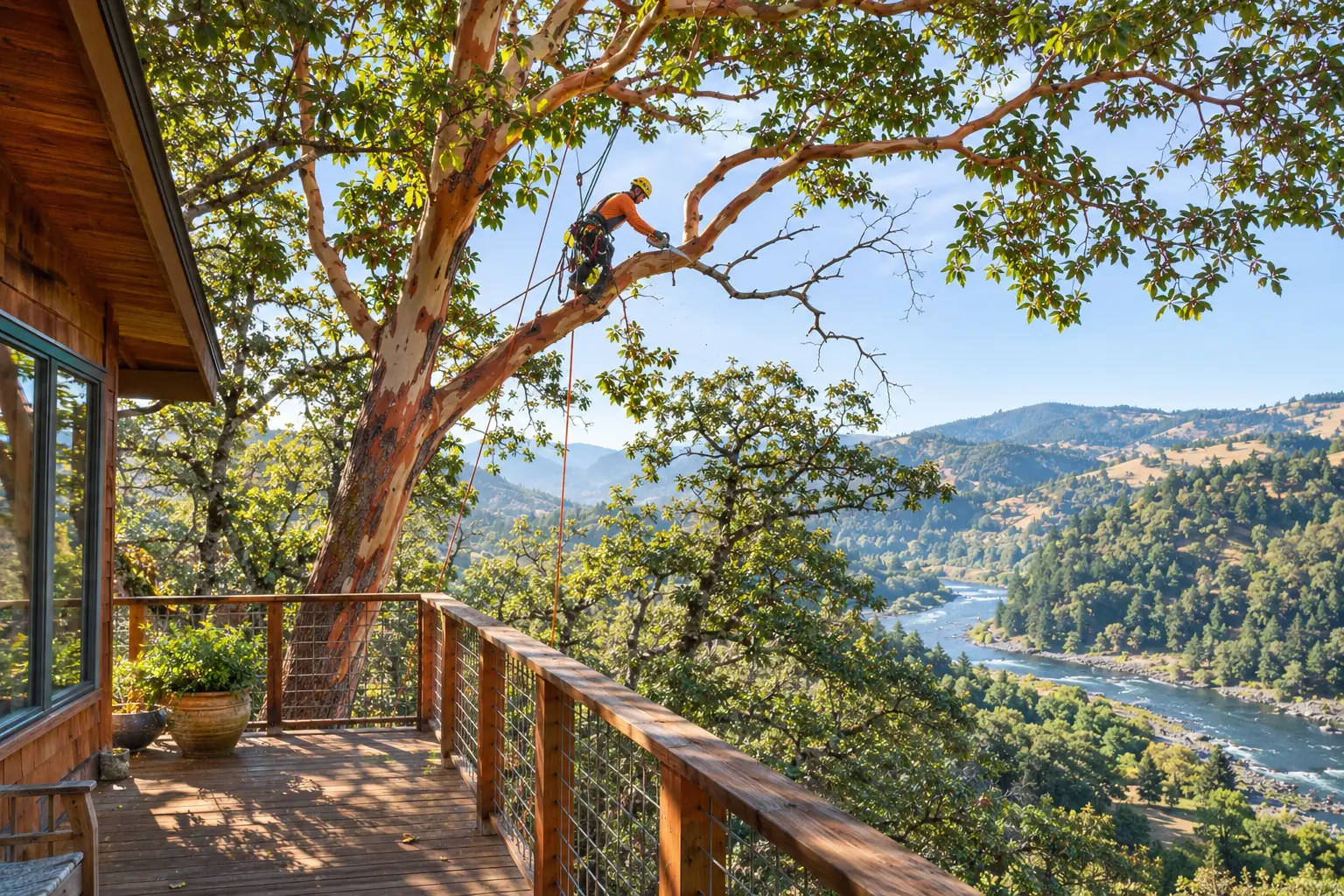
Hillside tree work around Gold Hill takes more planning than the same job on flat ground. Equipment may not reach the tree, cut wood has to be lowered and held so it cannot roll, and bare soil needs cover before winter rain. Call (541) 502-8114, and the one CCB-licensed tree service on the other end can be asked to walk the grade with you before any price is named.
Tree Service Gold Hill connects callers at no charge and owns no saws or trucks. It sends your call or form to an independent tree service, a single company, which plans and prices the work. Get that price on paper. This guide walks through what a slope changes for each type of tree service, how crews get gear and wood up and down a grade, what Gold Hill's code says about erosion and the Rogue River bank, and what to ask before anyone starts. The home page explains how the referral works.
What a slope changes for each kind of job
Every type of tree service gets harder on a grade, but not in the same way. The table shows the usual differences a company plans for.
| Job | On flat, open ground | On a steep lot |
|---|---|---|
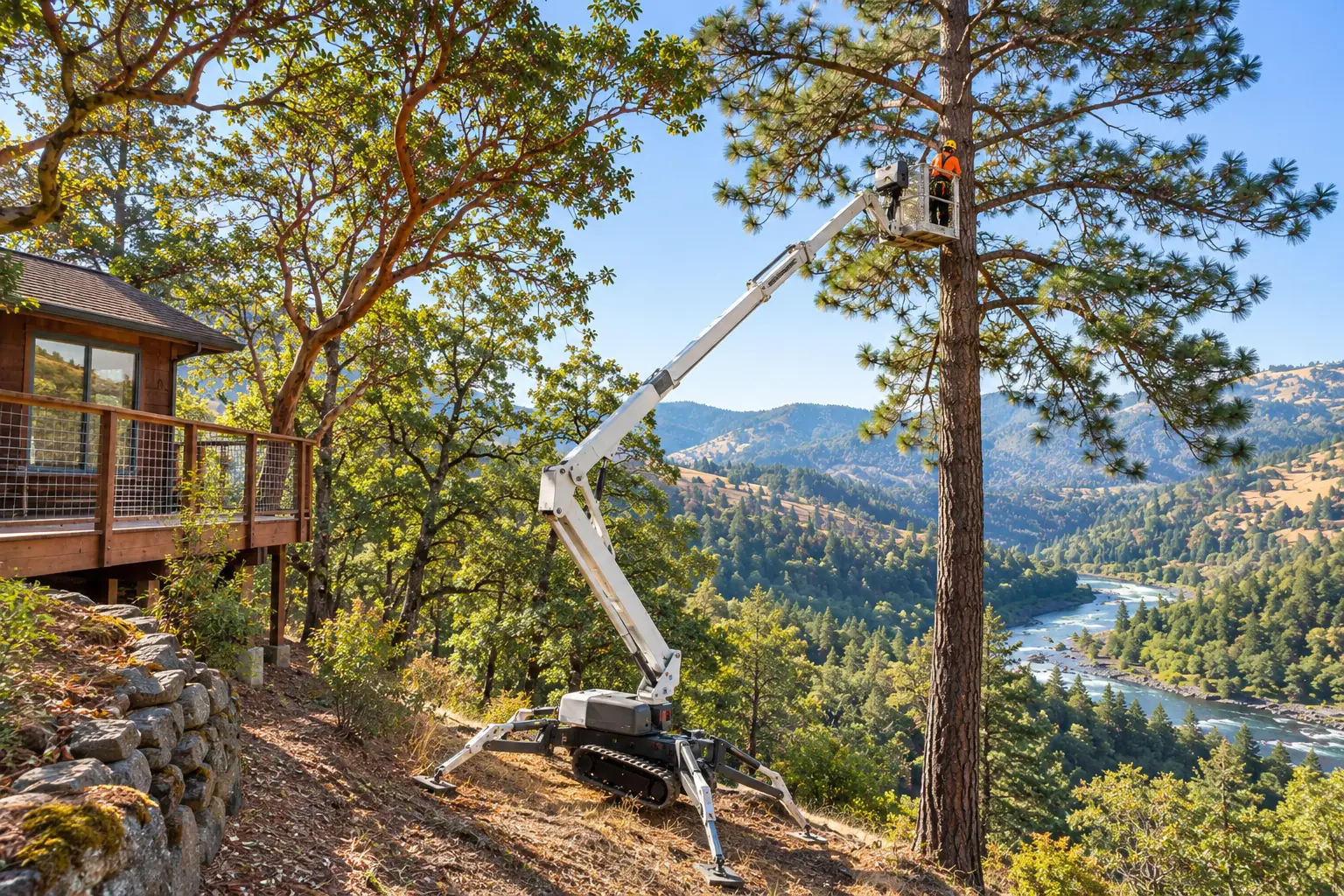
| Pruning and trimming | A bucket truck or lift can often reach the crown | A roped-in climber usually does the work, lowering limbs by rope |
| Tree removal | The tree may be felled into open ground | Taken down in short sections, each one tied off and lowered |
| Stump grinding | A larger grinder rolls up to the stump | A small or tracked grinder, or the stump left to hold the soil |
| Brush removal | Chipper parked beside the pile | Brush dragged or carried uphill to a chipper on the road |
The pruning and trimming page, the tree removal page and the stump grinding page explain each service in more detail.
Reaching the tree with trucks and lifts
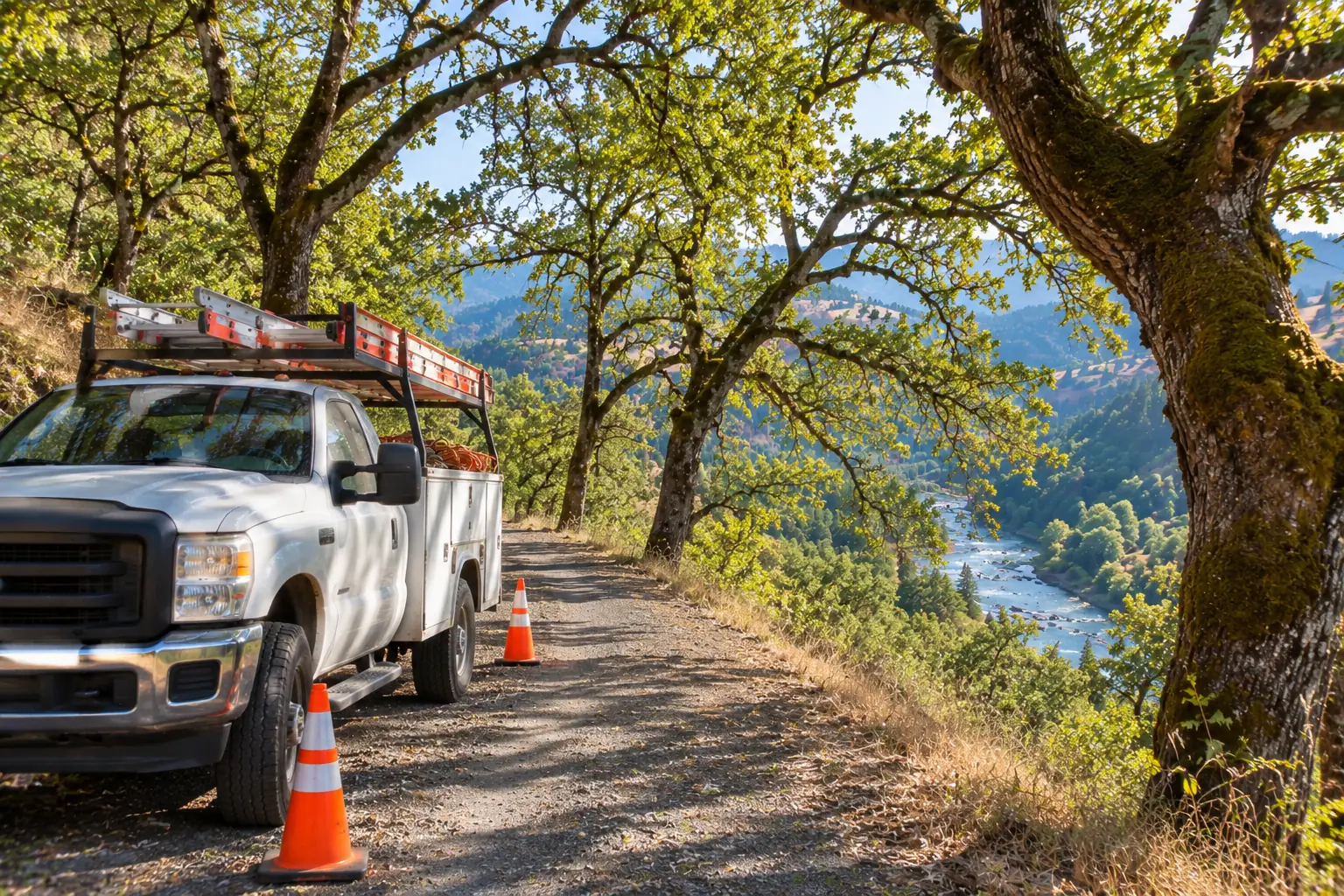
Access is the first thing a company sizes up on a steep property, because it decides which tools can be used. Large trucks and cranes need a firm, fairly level place to set up close to the tree. Smaller tracked lifts and grinders can go where wheels cannot, but they still need a path wide enough and solid enough to carry them.
Gather these details before the company visits so it brings the right gear.
- The driveway. How steep it is, how wide, whether it is paved or gravel, and where a truck can turn around.
- Gates and paths. The tightest gap a machine would have to squeeze through.
- Septic and drain field. Where they are, so heavy machines stay off them.
- Walls, decks and stairs. Anything between the parking spot and the tree that wood must pass over.
- Overhead wires. Pacific Power offers a free temporary disconnect so licensed professionals can work safely near the service wire to your home, according to its tree page. Call 1-888-221-7070 to ask.
If a stump is to be dug or ground below the soil, ask whether the company will request utility locates. Oregon 811 asks for notice at least two full business days, and no more than ten, before any excavation. You can reach it at 811 or 1-800-332-2344.
Keeping cut wood under control on a grade
On a slope, the main safety job is keeping every cut piece under control until it stops. A climber sets a rope through a pulley above the work, ties each limb or section before cutting it, and a ground worker lets it down slowly to a chosen spot.
Steep ground adds a few steps to that routine:
- Pick a landing spot. A level patch, or one backed by a log or bank on the downhill side.
- Cut short. A short log weighs less and is easier to stop once it lands.
- Chock every round. Logs are blocked or pinned before anyone walks below them.
- Keep people uphill. Nobody stands downslope of a piece that could move.
- Watch the neighbors. Wood is kept on your side of the property line and off any road below.
Pruning follows the same logic, since a heavy limb dropped onto a slope can slide into a fence or a car. Ask how the company will stop pieces from moving. If a storm has left a tree hung up or leaning over a house on a grade, see the emergency tree service page.
Protecting the soil after the work
Once trees or brush come off a slope, the bare ground beneath them can start to wash in the first heavy rains, so cover for the soil belongs in the plan.
Gold Hill's code shows what the city expects on permitted projects. Under Chapter 17.50 of the city's zoning code, a building or grading permit needs an approved erosion and sediment plan first when it would disturb any of these: 2,500 square feet or more of ground; land or native plants less than 50 horizontal feet from a river, stream, wetland or storm drain inlet; or 500 square feet or more where the grade is 10 percent or steeper. The chapter's plan standards include these points:
- During the rainy season, November through April, soils may not stay exposed for more than seven days in a row.
- Equipment may not be anchored to trees.
- Felled trees and cut brush have to stay inside the marked work area.
- Care must be taken not to injure trees and shrubs that are being kept.
Tree work that needs no permit may not be covered, so check with the city. The ideas still suit any steep lot:
| Step | Why it helps |
|---|---|
| Leave the stump and roots | They keep holding soil while new plants fill in |
| Spread wood chips over bare ground | A cover layer breaks the force of rain on the soil |
| Lay logs across the slope | OSU says contour logs must sit in full contact with the ground so water cannot run beneath them |
| Plant natives instead of relying on grass seed | OSU calls seeding a marginal practice on forest sites and warns against non-native grasses |
| Check after the first storms | Small rills are easier to fix than a slumped bank |
The contour log and seeding points come from OSU Extension's EM 9562, published July 2025, which was written for land after wildfire but deals with the same problem of bare, sloping soil.
Hillside lots that reach the Rogue River
When a lot slopes all the way to the river, riparian rules join the plan. Inside city limits, Chapter 17.49 of the same code protects a 75-foot strip measured from the river's top of bank. Plants and trees in that strip stay, apart from a short list of exceptions, one of which lets owners swap non-native plants for natives under a landscape plan. Grading and new structures are kept out of the strip too, other than a few allowed uses such as docks and utility lines.
Beyond city limits, the county uses a 75-foot setback on the Rogue and 50 feet on streams, according to a county guide from the local conservation district. That guide says clearing there needs approval and is allowed only in narrow cases, and that fuelbreak rules for wildfire do not override riparian protections.
For a tree near the bank inside town, phone City Hall first: (541) 855-1525. Outside town, start with Jackson County Development Services.
Fire on a slope
A slope below a house raises the fire stakes, so hillside lots usually need wider clearing than flat ones. In EM 9247, OSU Extension stretches the protective zone to 200 feet or beyond where the ground is steep and overgrown, and asks for wider gaps between groups of trees the steeper the lot. Its other targets are limbing tall trees 6 to 10 feet up and keeping crowns 10 feet or more off the house.
In practice, the work below a hillside home is mostly thinning young trees, cutting back the shrubs and raising the limbs of mature trees, and big trees often stay. Summer work also has to follow ODF's saw and engine hours. Those hours are laid out in the fire season rules guide, and the brush removal page and lot clearing page cover larger clearing jobs.
Picking the right time of year
Timing on a hillside is a trade between wet ground and fire rules. Early spring and the weeks after fire season ends in fall often work well, since saws can run all day and the ground is usually firmer than in midwinter.
- Winter. Saws can run all day, but soggy ground can keep machines off the slope, and the city's rainy season rule for permitted work limits how long soil may stay bare.
- Early spring. Ground firms up as it dries. A good window for thinning and limbing ahead of fire season.
- Summer. Dry, firm ground, but shorter saw hours, no burning and stops at extreme danger.
- Fall. Once fire season ends, long work days return. Cover bare soil before the November rains.
The tree service cost guide explains why hillside work costs more, and the madrone and oak care guide covers the native trees that hold many Gold Hill slopes together.
What to ask the company about your slope
Ask these during the estimate visit to see how a company plans to handle your slope.
- Where will the truck or lift set up, and can it reach the tree from there?
- Will a climber do the work, or a lift?
- How will pieces be kept from rolling toward the house, a road or a neighbor?
- Will the stump stay to hold the soil, and how will bare ground be covered?
- Will brush be chipped on the road, hauled away or left?
- What is your Oregon CCB number, and can I see proof of insurance?
Any CCB number can be looked up on the Oregon CCB license search. To send these details in writing, use the estimate request page.
Frequently asked questions
Why does tree work cost more on a steep lot?
Slopes slow every step. Equipment may not reach the tree, so climbers do more by hand, each piece is roped down and blocked, and brush is carried uphill to a chipper. That adds hours and crew.
Should I grind the stump after a tree comes off a slope?
Leaving it is often kinder to the slope, because the old roots go on gripping the soil as fresh plants fill in. Ask the company before it is ground out.
Do I need a permit to remove trees near the Rogue River in Gold Hill?
Inside city limits, Gold Hill's code keeps trees and other plants in place within 75 feet of the river's top of bank, apart from a few exceptions. Ask City Hall, (541) 855-1525, what applies before any cutting.
Can heavy equipment damage my septic system on a hillside?
Heavy machines can crush tanks and pipes or pack drain field soil. Show the company where your septic tank and drain field are so it keeps trucks and grinders off them.
When is the best time for tree work on a slope near Gold Hill?
Early spring and the fall weeks after fire season ends are often easiest. Saws can run all day, and the ground is firmer than in a wet midwinter. Winter works too when machines can stay off soggy ground.