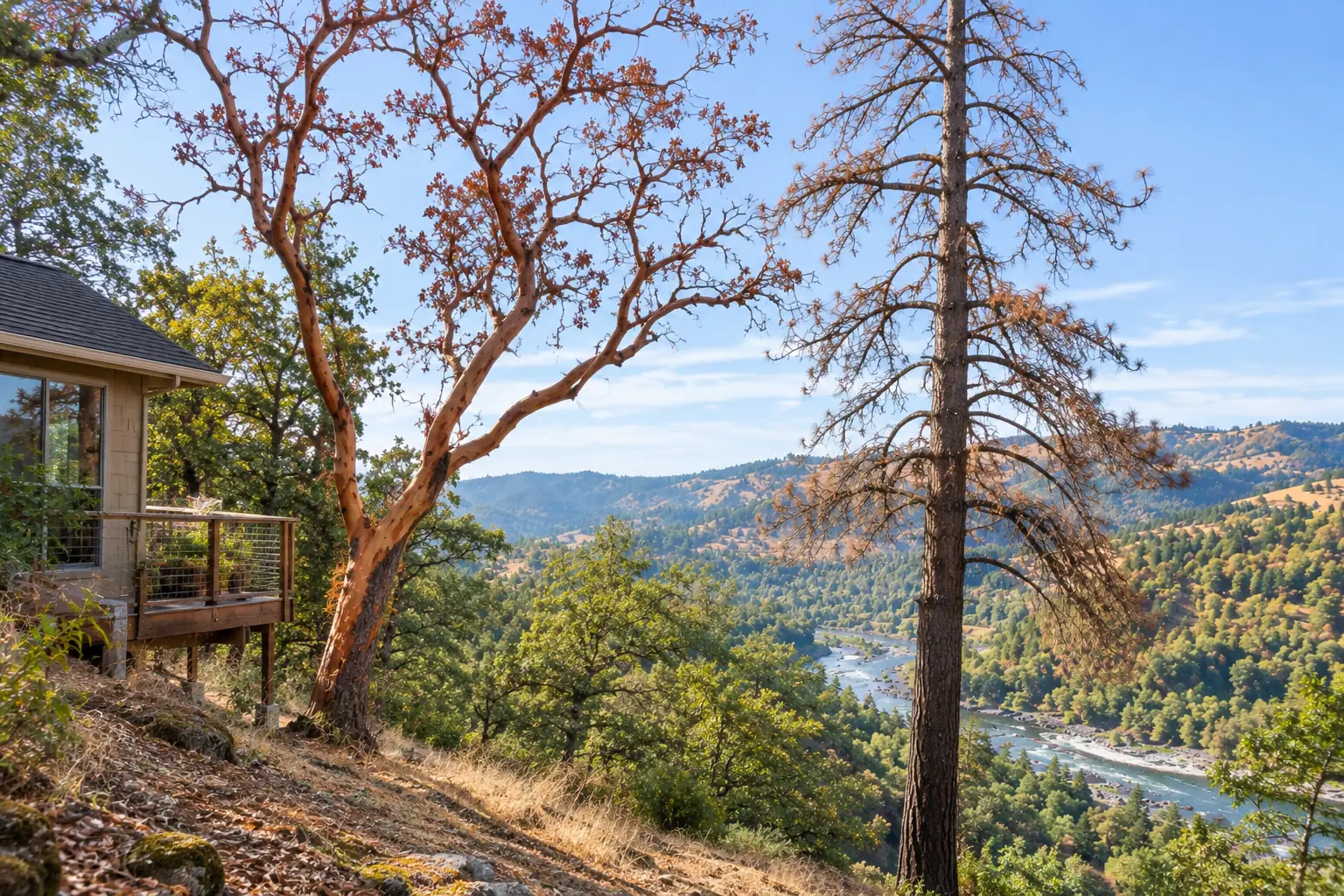
Dead tree removal in Gold Hill takes down a tree that has died standing, usually a Douglas-fir, pine or madrone, before it drops limbs or falls on a house, a road or a fence. To have a dead tree looked at, call (541) 502-8114. You are connected with an independent tree service that holds an Oregon CCB license. It is a single company, and a paper estimate is yours for the asking.
Tree Service Gold Hill refers calls and does nothing else. It does not inspect trees, cut them or set prices. A dead tree that has stood unchanged for a while is regular work, not an emergency, but it is the kind of job worth booking before winter storms or fire season. This page covers how to confirm a tree is dead, why Douglas-firs on the dry hills around Gold Hill have been dying, why dead wood changes how a crew works, the local rules, and the questions to ask. The home page explains the referral.
How to tell a tree is dead, not dormant
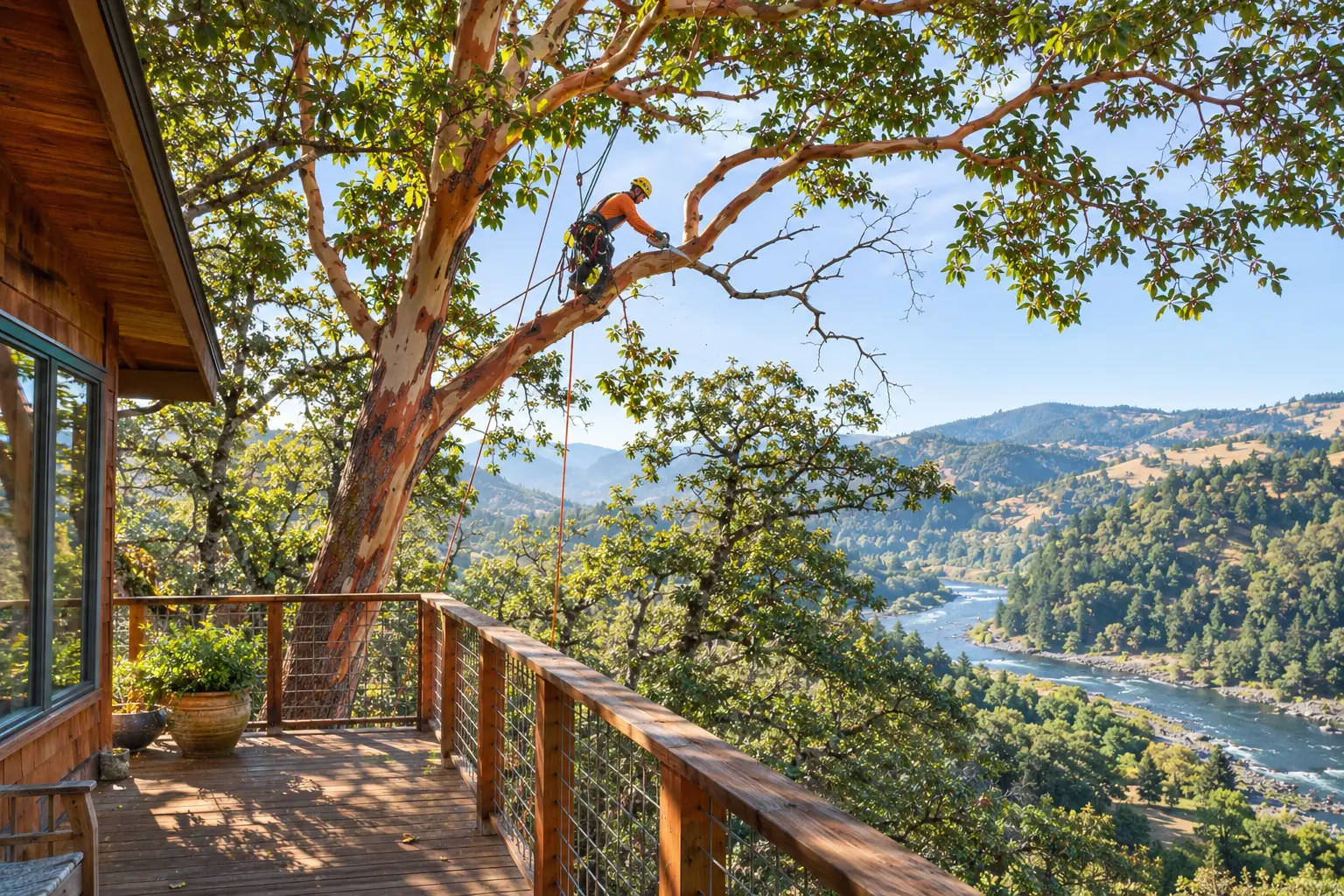
A dead tree has no live foliage in the growing season and no green tissue under the bark. Oaks drop leaves every fall, so winter alone proves nothing for them. Check in late spring or summer, or look for these signs:
| What you see | What it usually means |
|---|---|
| Needles turned red or brown across the whole crown of a pine or fir | The tree has likely died within the last year |
| Bare gray branches, bark sloughing off in sheets | Dead for a year or more, wood drying out |
| No leaves on a madrone or oak by midsummer | Likely dead, or nearly so |
| Scratching a twig shows brown, dry wood instead of green | That branch, at least, is dead |
| Woodpecker flaking on a Douglas-fir's bark | Often borer activity under the bark |
| Fungus shelves or mushrooms at the base | Decay in the trunk or roots |
The University of California's hazardous tree guide lists conks, mushrooms and other fungal fruiting bodies on bark or around the base among its warning signs. When only part of a crown is dead, the tree may still be saved with pruning, and a tree health check is the better first call.
Why so many Douglas-firs near Gold Hill are dying
Douglas-fir decline has hit the warm, dry edges of the Rogue and Applegate valleys hard. OSU Extension's EM 9406, Trees on the Edge (September 2023), traces it to three factors acting together: harsh, dry sites, hotter droughts, and insects, mainly the flatheaded fir borer.
The publication says sites with less than 35 inches of average annual rain and under 3,500 feet in elevation are at highest risk, along with steep south- and west-facing slopes where afternoons are hottest. It lists warning signs: dying tips and tops, thinning or yellowing foliage, branches that go red then gray, a heavy crop of small cones near the top, small pitch droplets in the bark and woodpeckers flaking the bark. It says that once bark flaking appears, the tree's death is almost certain.
OSU also says little or nothing can be done to save a fir that is far into decline. For high-risk sites it suggests removing declining Douglas-fir in favor of heat- and drought-tolerant trees such as pines and oaks. That makes a dying fir above a house a removal job, and often a chance to give a nearby oak or pine more room. The madrone and oak care guide covers those keepers.
Pines. Dead and dying ponderosa pines often host bark beetles. ODF's slash fact sheet (April 2021) warns that fresh pine slash breeds Ips beetles, and it says slash 3 to 8 inches across cut from January through September should be chipped, burned, masticated or buried before beetles fly in April, or within two months. Ask the company how it will handle pine wood from the job.
Why dead trees are harder to take down
Dead wood behaves differently under a saw, and that changes the method and the price. As a tree dries, its limbs become brittle and its trunk can decay from the inside, so pieces can snap off sooner than a climber expects. Lawn Love's removal cost guide notes that a dead tree can be harder to cut because its wood may be more brittle.
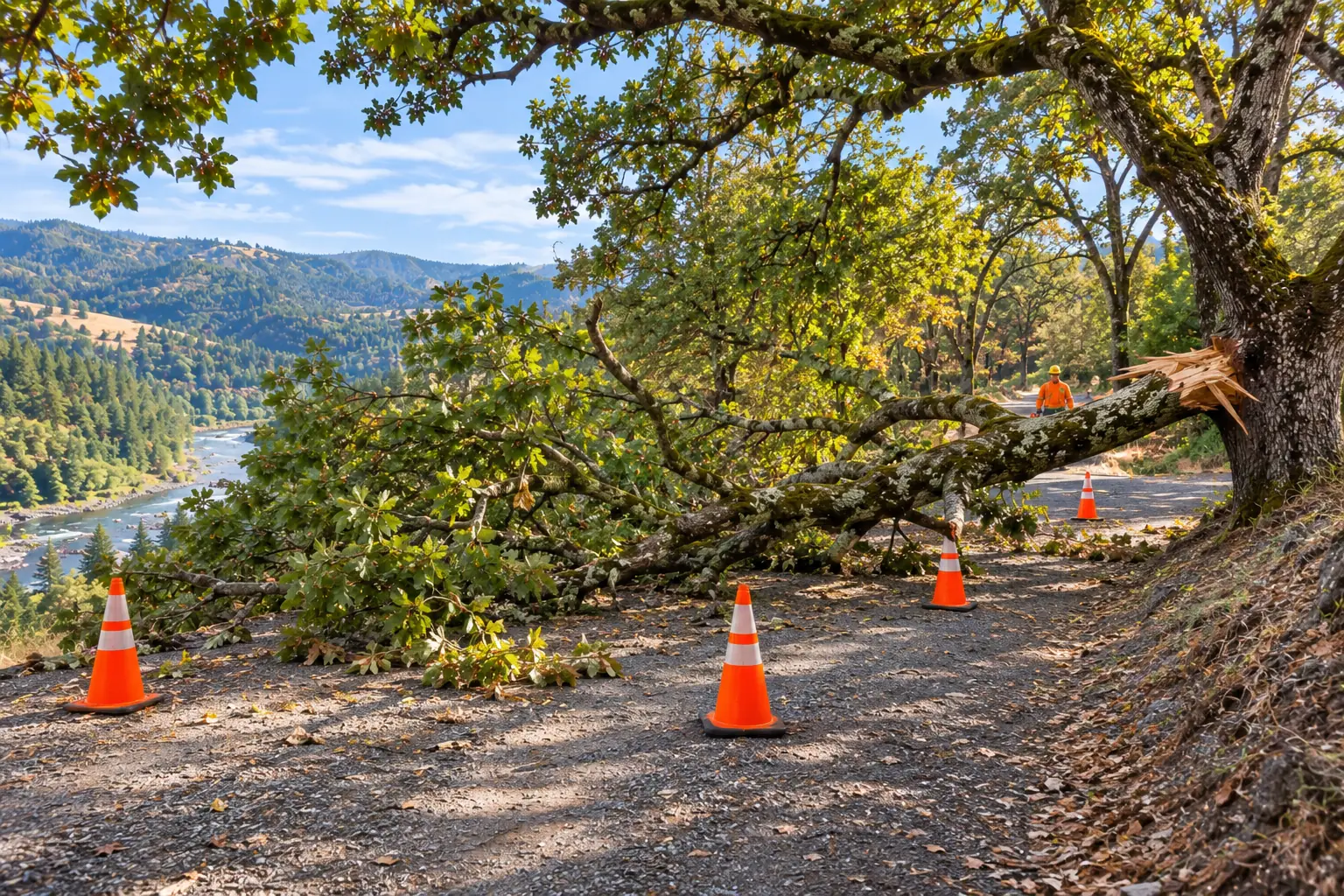
For that reason, many crews avoid climbing a dead tree of any size. Common approaches include:
- Felling from the ground when there is clear, open space in the direction of the fall.
- Working from a lift so no one has to tie into dead wood. Tracked spider lifts can reach up slopes where a bucket truck cannot park.
- Using a crane for a large dead tree over a house, so each piece is held before it is cut.
- Pulling the tree over with a rope and winch in a planned direction once the cuts are made.
Ask the company how it will reach a dead tree and why. An honest answer about the risk of climbing dead wood is a good sign. The hillside tree work guide covers access on steep lots.
Gold Hill's rule on dead and decaying trees
Inside city limits, a hazardous dead tree is the owner's responsibility. Section 8.08.100 of Gold Hill's Title 8 says no owner or person in charge of property may allow a dead or decaying tree to stand when it is a hazard to the public or to people or property on or near the land. The same section makes the owner or occupant next to a parking strip responsible for trees on that strip.
There is one place to slow down. Section 17.49.040 of the city's Title 17 keeps vegetation and tree cover within 75 feet of the top of the Rogue River bank, with limited exceptions, and the chapter does not list a separate exception for dead or hazard trees. If a dead tree stands in that band, call Gold Hill City Hall at (541) 855-1525 and ask how the city wants it handled before anyone cuts.
Outside the city, the Jackson Soil and Water Conservation District's riparian guide says the county uses a 75-foot setback on the Rogue and 50 feet on other streams, and that removing trees there needs approval. Jackson County Planning is at 541-774-6907.
Dead trees and wildfire
Dead trees and dead wood are fuel. The Oregon State Fire Marshal's defensible space page tells owners to dispose of heavy ground litter and deadwood and to remove ladder fuels under trees. A dead pine next to a house with needles on the roof is a direct link between the forest and the building.
Time the work with fire season in mind. ODF's 2026 Southwest Oregon regulated closure bans power saws at extreme fire danger and limits them to mornings and evenings at moderate and high danger. A dead tree removed in spring or fall avoids those limits, and the fire season rules guide has the details.
What dead tree removal costs
Cost guides do not agree on whether dead trees cost more or less, because it depends on how the tree has to come down. LawnStarter's removal price guide, updated October 5, 2026, says dead or weak trees often cost less to remove than healthy ones, but that a stable sick tree can cost as much. Lawn Love's guide, updated the same day, says diseased or storm-damaged trees cost more than healthy trees, which it puts at $400 to $1,000.
The general ranges from those guides are a typical $385 to $1,070 (LawnStarter) and a national average of $850 (Lawn Love). A dead tree in an open field that can be felled whole sits low. A tall dead fir leaning over a house on a slope, needing a lift or a crane, sits high. The written estimate from the company you are connected with is the actual price. Compare it with the other jobs on the tree service cost guide.
Questions to ask about a dead tree
- Will anyone climb this tree, or will you work from a lift, a crane or the ground?
- Which way will it fall, and what protects the house, the fence and the septic system?
- What will you do with pine wood so it does not breed bark beetles?
- Is the stump included? See stump grinding for that step.
- Does the tree stand within 75 feet of the river or a creek, and have you checked with the city or county?
- What is your CCB number? Look it up on the Oregon CCB license search.
Frequently asked questions
Is a dead tree an emergency?
Usually not, if it has looked the same for weeks and has not hit anything. It becomes urgent if it cracks, starts leaning toward a house or drops a big limb on something. The emergency tree service page lists the urgent cases.
Can a dying Douglas-fir be saved?
Sometimes, if decline is caught early on a good site. OSU Extension says little or nothing can save a fir that is severely declining, and that once woodpecker bark flaking appears, death is almost certain.
Does Gold Hill make owners remove dead trees?
City code says an owner may not allow a dead or decaying tree that is a hazard to the public, or to nearby people or property, to stand. Ask City Hall how it applies to your tree.
Can I leave a dead tree for wildlife?
A snag far from homes, roads and paths can be left in some cases. Near a house, a driveway or a power line, the risk usually outweighs the benefit. Ask the company and, near water, the city or county.
Should a dead tree come down before fire season?
It is the easier time. From mid May, saw hours shrink with the fire danger level, and dead wood near a house adds fuel. Spring and fall are the smoothest windows.